
Starting your first home healthcare assignment can feel exciting, meaningful, and a little unfamiliar.
Whether you are an RN, LPN, LVN, CNA, HHA, LHA, or a nurse exploring private duty nursing for the first time, home healthcare is different from many other care settings. Instead of caring for multiple patients in a hospital, facility, or clinic, you may be providing one-on-one care in a patient’s home, surrounded by their family, routines, equipment, and daily life.
That difference is what makes home healthcare so personal.
It is also what makes preparation so important.
If you are new to home health nursing, private duty nursing, or in-home care, these tips can help you feel more confident as you begin your first assignment. From learning to trust your assessment skills to building relationships with families, these are the lessons that can help nurses grow in home healthcare.
Quick Answer: What Should Nurses Know Before Their First Home Healthcare Assignment?
Nurses should know that home healthcare requires strong assessment skills, clear communication, respect for the home environment, and the ability to build trust with patients and families. Unlike a hospital or facility setting, home healthcare often involves one-on-one care, greater independence, and a deeper understanding of the patient’s daily routine, family dynamics, and care goals.
At Team Select Home Care, nurses are supported through clinical guidance, communication with care teams, patient-specific preparation, and meaningful one-on-one care opportunities. Whether you are beginning your home healthcare journey or transitioning from another care setting, the goal is to help you feel prepared, supported, and confident as you provide care in the home.
A Different Kind of Nursing Career Starts Here
Home healthcare can feel new at first, but you do not have to figure it out alone. Team Select supports nurses and caregivers with clinical guidance, communication, patient-specific preparation, and opportunities to provide meaningful care for medically complex children and adults at home.
Whether you are beginning your nursing career or looking for a change from hospital or facility-based care, home healthcare offers the opportunity to build meaningful relationships, provide one-on-one support, and help patients receive care in the comfort of their home.
At Team Select Home Care, nurses and caregivers are supported with clinical guidance, communication, patient-specific preparation, and opportunities to care for medically complex children and adults.
Visit Here To Explore Nursing Opportunities
What Is a Home Healthcare Assignment?
A home healthcare assignment is a scheduled shift or visit where a nurse or caregiver provides care to a patient in the home. Depending on the patient’s needs, this may include skilled nursing, private duty nursing, personal care support, monitoring, documentation, communication with the care team, and assistance with daily routines.
In private duty nursing, nurses often provide one-on-one care for patients with complex medical needs. This may include pediatric or adult patients who require ongoing support due to respiratory needs, tracheostomy care, ventilator support, feeding tubes, seizure monitoring, medication administration, or other skilled care needs.
Each assignment is different because each patient and family is different. That is why home healthcare nurses need clinical skill, flexibility, communication, and compassion.
Why Home Healthcare Feels Different From Facility-Based Care
Home healthcare is unique because the care environment is also the patient’s personal space.
You are not just walking into a room number or a unit. You are entering someone’s home, routine, and family life. That means your role includes clinical care, but it also includes respect, relationship-building, communication, and awareness of the home environment.
In home healthcare, nurses often have the opportunity to:
- Focus on one patient at a time
- Build meaningful relationships with patients and families
- Learn a patient’s baseline, routines, and preferences
- Use strong assessment and communication skills
- Support patients in the comfort and familiarity of home
- Work with clinical teams, office teams, families, and physicians to coordinate care
For many nurses, this one-on-one care model is what makes home healthcare so rewarding.
10 Things Nurses Should Know Before Their First Home Healthcare Assignment
1. Listen More Than You Talk
When you enter a patient’s home, remember that the family has often been living this reality long before your first shift.
They may know the patient’s routines, preferences, communication style, early warning signs, comfort measures, and daily patterns better than anyone else. Listening first helps you understand the home, the patient, and the family dynamic before trying to take over the flow of care.
For new home health nurses, listening is also a powerful way to build trust. Families want to know that you respect their experience and that you are willing to learn from them.
This does not mean ignoring your clinical training. It means combining your nursing judgment with the family’s lived experience.
On your first assignment, listen for:
- How the patient communicates comfort or discomfort
- What the family considers the patient’s normal baseline
- Daily routines that help care go smoothly
- Family preferences around communication and privacy
- Small details that may not be obvious in the care plan
At Team Select, home healthcare works best when nurses, families, clinical teams, and care coordinators stay aligned. Listening is one of the first ways to create that partnership.
2. Don’t Be Afraid to Ask Questions
No one expects you to know everything on day one.
In home healthcare, asking questions is not a weakness. It is part of safe, responsible care. Even experienced home health nurses ask questions when they are learning a new patient, a new family routine, a new care plan, or a new piece of equipment.
Before and during your first assignment, ask questions about:
- The patient’s care plan
- Medication routines
- Documentation expectations
- Emergency procedures
- Equipment setup
- Supplies
- Who to contact with clinical concerns
- When and how to escalate changes
If something feels unclear, ask before guessing. Home healthcare may require more independence than some facility-based roles, but independence does not mean isolation.
At Team Select, nurses are supported 24/7 by clinical leaders, office teams, and care teams who understand that communication helps protect patients and support nurses in the field.
3. Build Trust Before Anything Else
Clinical skills matter, but trust is what allows home healthcare to work.
Families are inviting you into their home, their routines, and their lives. That level of access requires professionalism, consistency, and respect. Trust is built through small, repeated actions: showing up prepared, communicating clearly, following through, respecting privacy, and taking the time to understand the patient as a person.
For nurses starting a home healthcare assignment, trust can begin with simple steps:
- Introduce yourself warmly and professionally
- Review the care plan carefully
- Ask how the family prefers communication
- Respect the home environment
- Be honest when you need clarification
- Follow agency policies and documentation expectations
- Keep personal and professional boundaries clear
In one-on-one care, relationships develop over time. A strong relationship with a patient and family can make care feel more coordinated, comfortable, and meaningful.
4. Learn the Child, Not Just the Diagnosis
In pediatric home healthcare, two children with the same diagnosis can have completely different needs, routines, personalities, and communication styles.
A diagnosis may explain part of the care plan, but it does not tell the whole story. To provide strong care, nurses need to understand the child behind the diagnosis.
That may include learning:
- How the child communicates
- What helps them feel calm
- What routines matter to the family
- How they respond to care
- What signs may suggest discomfort or distress
- What activities, songs, toys, or interactions they enjoy
- What the family considers a good day
This same idea applies to adult home health patients as well. Every patient has preferences, habits, and a life beyond their clinical needs.
At Team Select, patient-specific preparation and individualized care help nurses support the whole person, not just the condition. Home healthcare gives nurses the opportunity to understand the patient in a deeper, more personal way.
5. Be Observant
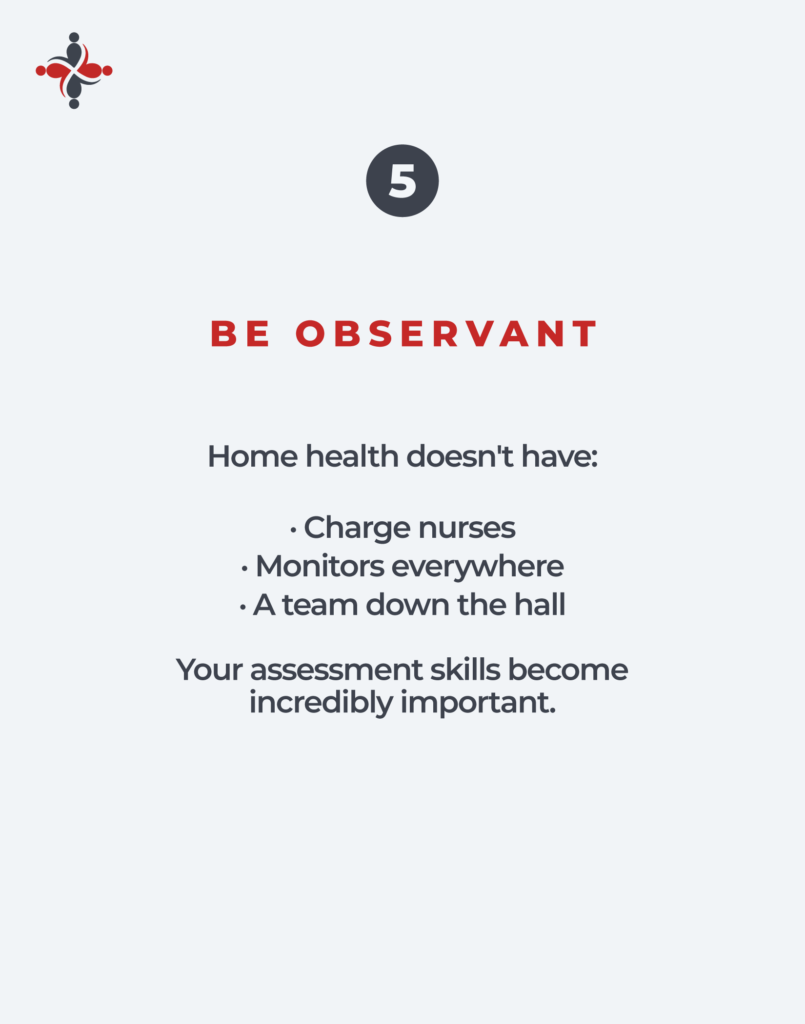
Assessment skills become incredibly important in home healthcare.
In a hospital or facility, there may be monitors, charge nurses, rapid response teams, and other clinicians physically nearby. In the home, you may be the person most closely observing changes in the patient during your shift.
That means small details matter.
A change in breathing, color, secretions, sleep, feeding tolerance, behavior, energy level, or communication may be important. The more you understand the patient’s baseline, the better you can recognize when something is different.
New home health nurses should pay attention to:
- Respiratory changes
- Skin color or temperature
- Changes in appetite or feeding tolerance
- Increased irritability or lethargy
- Seizure activity or unusual movements
- Medication response
- Equipment concerns
- Family observations
- Changes from the patient’s normal routine
Observation alone is not enough. Communicating what you notice is just as important. Document carefully, follow agency procedures, and escalate concerns through the appropriate channels.
Strong assessment, clear documentation, and timely communication help support safer care at home.
6. The Family Is Part of the Team
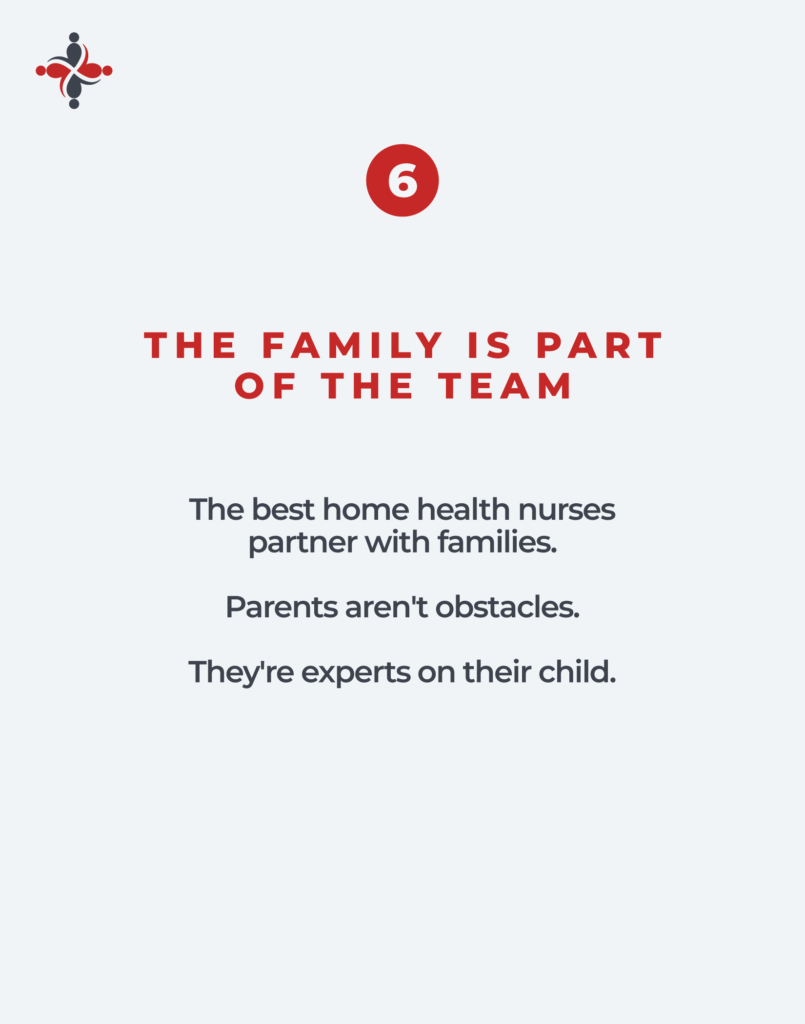
Families are not obstacles. They are essential partners in care.
In home healthcare, family members often know the patient’s daily life better than anyone. They may recognize subtle changes, understand routines, and provide important context that supports the care plan.
The best home health nurses approach families with respect. They understand that parents, guardians, spouses, and caregivers often carry significant emotional, physical, and logistical responsibility.
Partnering with families may include:
- Listening to their observations
- Respecting their routines
- Explaining care clearly when appropriate
- Communicating changes or concerns
- Asking how care is usually done in the home
- Maintaining professional boundaries
- Recognizing that families are experts on their loved one
At Team Select, family-centered care is an important part of supporting medically complex patients at home. Nurses, families, physicians, case managers, and care teams all play a role in helping care feel consistent and coordinated.
7. Bring Humility

A great home health nurse brings both clinical skill and humility.
You may have training, experience, and strong instincts, but every home is different. Every family has its own routines. Every patient has their own preferences. Walking in with humility helps you learn faster, connect more naturally, and earn trust over time.
Humility can look like:
- Asking how the family usually approaches a routine
- Admitting when you need clarification
- Being open to feedback
- Learning the patient’s preferences
- Respecting the family’s home
- Understanding that confidence grows with experience
Families appreciate honesty more than pretending to know everything. If you are new to home healthcare, it is okay to be learning. What matters is that you stay safe, ask questions, follow the care plan, and remain open to support.
8. Prepare for Independence
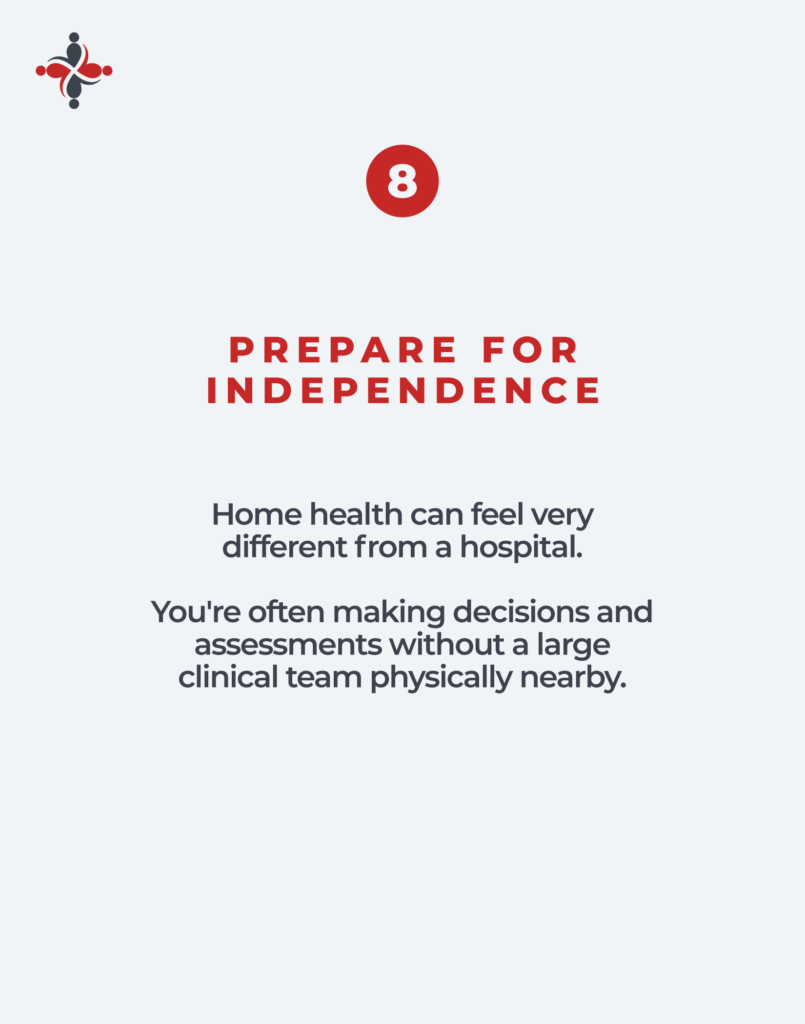
Home healthcare can feel very different from a hospital or facility because a large clinical team may not be physically nearby.
That independence can be empowering, but it also requires preparation. You need to understand the care plan, know who to contact, recognize changes, document accurately, and communicate concerns clearly.
Preparing for independence means knowing:
- The patient’s baseline
- The care plan and physician orders
- Emergency procedures
- Medication and treatment schedules
- Equipment use
- Documentation requirements
- Who to call for clinical or scheduling support
- When to escalate concerns
It is important to remember that working independently does not mean working alone.
At Team Select, nurses in the field are supported by clinical supervisors, office teams, and care coordination processes designed to help them feel prepared and connected. The nurse may be the one physically in the home, but there is a broader team behind the care.
9. Celebrate Small Wins

Progress in home healthcare does not always look dramatic.
Sometimes, success looks like a completed feeding, better sleep, a calmer shift, improved tolerance, a therapy milestone, a peaceful moment, or a smile after a difficult day.
Those moments matter.
In home healthcare, nurses often get to witness progress in a deeply personal way. You may see a child become more comfortable with a routine, a family feel more confident, or a patient experience a better day because they are supported at home.
Small wins are part of what makes home healthcare meaningful.
They remind nurses that care is not only about tasks and documentation. It is also about quality of life, comfort, dignity, and connection.
10. You’re Entering Their Home
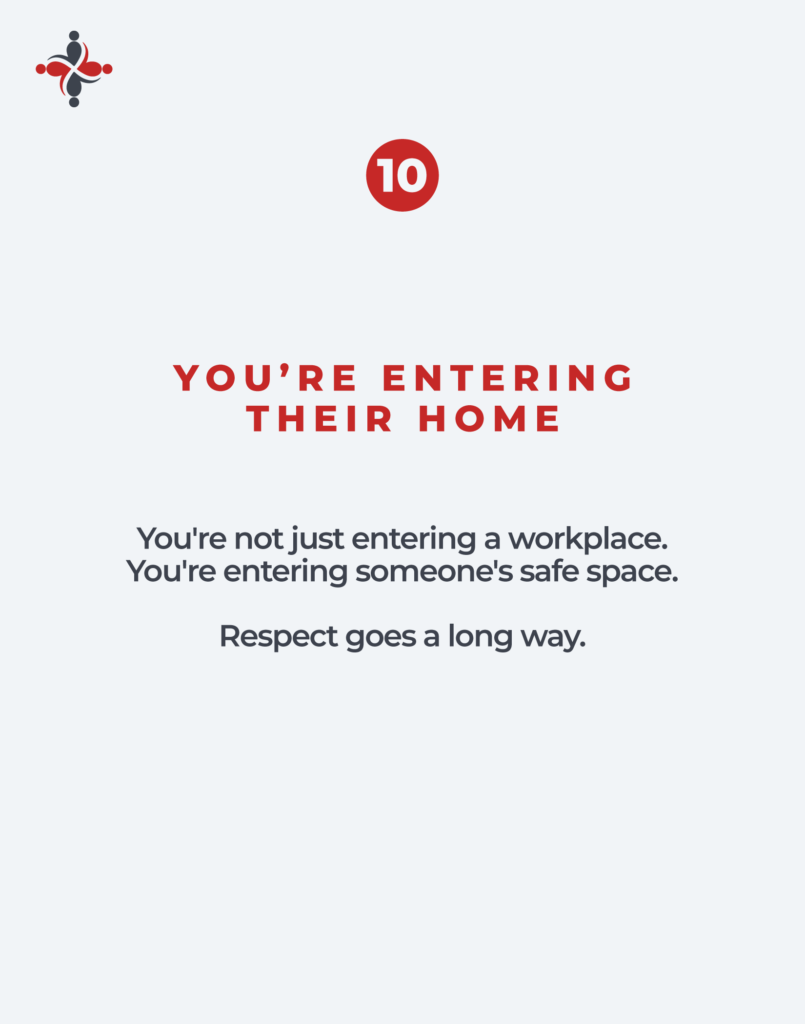
A home healthcare assignment is not just a workplace. It is someone’s safe space.
That means respect matters from the moment you arrive. You are stepping into a home where a patient and family live, rest, struggle, celebrate, and build routines around care.
Professionalism in the home includes:
- Arriving on time and prepared
- Respecting privacy
- Following infection control and safety expectations
- Keeping personal phone use appropriate
- Maintaining boundaries
- Being mindful of conversations
- Respecting household routines
- Treating the home environment with care
Home healthcare is personal. Nurses who understand that often build stronger, more respectful relationships with patients and families.
At Team Select, compassionate care means recognizing both the clinical needs of the patient and the humanity of the home environment.
Finding Home Healthcare Nursing Jobs Near You
If you are considering a home healthcare career, look for an agency that supports nurses before, during, and after their assignments.
Home health nursing opportunities can vary by state, licensure, service line, and patient need. Nurses searching for home healthcare nursing jobs near them should look for a provider that offers communication, clinical support, patient-specific preparation, scheduling guidance, and assignments that match their skills and comfort level.
Common searches may include:
- Home health nursing jobs near me
- Private duty nursing jobs near me
- Pediatric home health nursing jobs near me
- LPN home health jobs near me
- LVN private duty nursing jobs near me
- RN private duty nursing jobs
- CNA home care jobs near me
- HHA jobs near me
Team Select Home Care offers opportunities for compassionate nurses and caregivers who want to provide meaningful one-on-one care in the home. Role availability may vary by location, licensure, and patient needs.
Why More Nurses Are Choosing Home Healthcare
Home healthcare gives nurses the opportunity to make a difference in a highly personal setting.
For some nurses, the appeal is one-on-one care. For others, it is the chance to build lasting relationships with patients and families, focus deeply on one patient’s needs, or move into a care environment that feels more personal than a traditional facility setting.
It is also a growing area of healthcare overall. According to the U.S. Bureau of Labor Statistics, employment of registered nurses is projected to grow 5% from 2024 to 2034, with about 189,100 RN openings projected each year, on average, over the decade. Home health and personal care aide roles are projected to grow even faster, at 17% from 2024 to 2034, with about 765,800 openings projected each year.
For nurses and caregivers, that growth reflects a larger shift: more care is happening outside of traditional hospital walls. CMS describes home health as medically necessary skilled care that may include nursing, therapy, and other services ordered by a physician.
Nurses may choose home healthcare because it can offer:
- One-on-one patient care
- Meaningful patient and family relationships
- Opportunities to build assessment skills
- Pediatric and adult care experience
- A more personal care environment
- Flexible scheduling opportunities
- A chance to support patients where they feel most comfortable
At Team Select, nurses are seen as Life Changers because the work they do in the home can change daily life for patients and families. Whether a nurse is beginning their career, transitioning from a hospital or facility, or looking for more personal patient connection, home healthcare can offer a meaningful path forward.
Ready to Make a Difference Through One-on-One Care?
Team Select Home Care is hiring compassionate RNs, LPNs, LVNs, CNAs, HHAs, and LHAs across multiple states. If you are beginning your home healthcare journey or looking for a more meaningful way to use your skills, Team Select can help you explore opportunities in one-on-one care.
View Open Positions With Team Select
Frequently Asked Questions About Home Healthcare Nursing Assignments

