
For parents of medically complex children, understanding care options can feel overwhelming.
You may hear different information from providers, insurance plans, case managers, other families, or online searches. Some of it may be helpful. Some of it may be incomplete. And some of it may make pediatric home health care feel more confusing than it needs to be.
Misconceptions can make families wait longer than they need to ask questions. They can also make parents wonder whether their child qualifies, whether their child has to stay home all day, whether a nurse can support school routines, or whether accepting nursing support means giving up their role as a parent.
The truth is that pediatric home health care is not one-size-fits-all.
Eligibility, services, coverage, and available support depend on several factors, including your child’s medical needs, physician orders, medical necessity, payer requirements, state guidelines, staffing availability, and services available in your area.
This guide separates six common myths from the facts so families can better understand pediatric home health care, Private Duty Nursing, school support, parent involvement, and when to reach out for help.
Quick Answer: What Should Families Know About Pediatric Home Health Care?
Pediatric home health care may help medically complex children receive skilled nursing services and support in the comfort of home, depending on medical need, physician orders, eligibility, payer requirements, and available services.
For some families, pediatric home health care may include Private Duty Nursing, skilled nursing visits, support with medical equipment, medication administration, respiratory care, feeding support, seizure monitoring, care coordination, family education, and help navigating available resources.
Families should also know that pediatric home health care does not replace the parent. Nurses work alongside families, follow physician-directed care plans, communicate with the care team, and help support the child’s needs in daily life.
If you are unsure whether your child may qualify, you do not need to have every answer before asking questions. Your child’s physician, case manager, insurance plan, or a pediatric home health care provider can help you understand possible next steps.
Myth 1: My Child Has to Have the Most Complex Medical Needs to Qualify
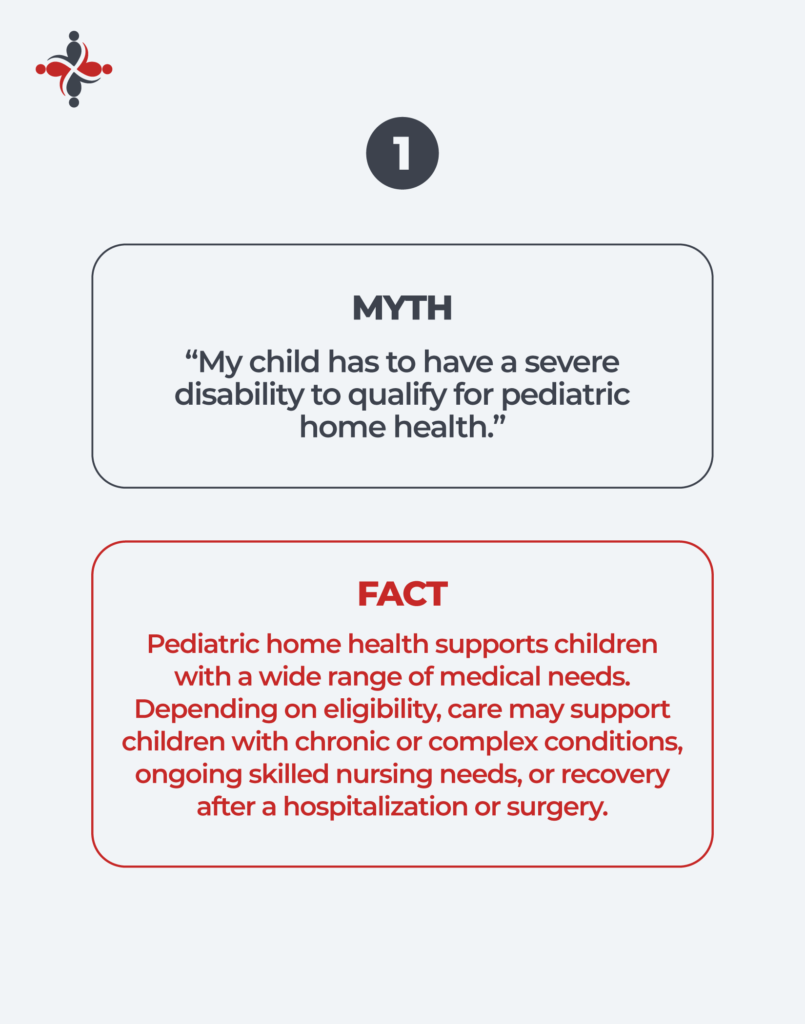
Many families assume pediatric home health care is only for children with the highest level of medical need.
That is not always true.
Some children who qualify for pediatric home health care have complex respiratory needs, tracheostomies, ventilators, feeding tubes, oxygen support, seizure monitoring needs, medication routines, mobility needs, or other ongoing skilled care needs. Other children may need support after a hospital stay, during a transition home, or because daily medical routines have become difficult for the family to manage alone.
Eligibility is not based on one diagnosis alone. It is usually based on the child’s medical needs, physician orders, required level of care, insurance or Medicaid requirements, state guidelines, and available services.
For children enrolled in Medicaid, EPSDT guidance explains that medically necessary services are evaluated based on the individual child’s needs and whether services are needed to correct or ameliorate the child’s condition.
If you are unsure whether your child may qualify, the best first step is to ask. A physician, hospital discharge planner, case manager, insurance plan, or local pediatric home health care provider can help you better understand what documentation or next steps may be needed.
Myth 2: My Child Has to Be Homebound to Receive Pediatric Home Health Care
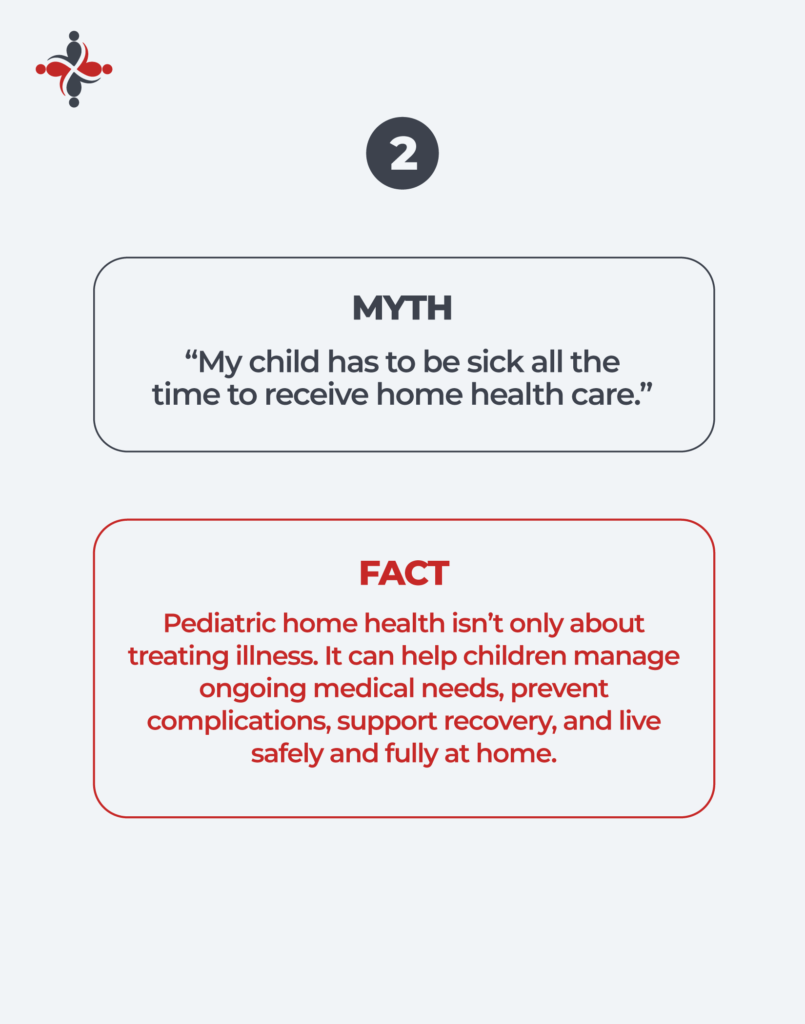
This is one of the most common questions parents ask.
The answer depends on the payer, program, state, and type of service. Some adult home health care benefits, especially Medicare-related benefits, use homebound requirements. Pediatric home health care, Medicaid home health services, and Private Duty Nursing may work differently depending on the child’s coverage and state program.
Federal Medicaid home health regulations state that home health services cannot be limited only to beneficiaries who are homebound and may be provided in settings where normal life activities take place, with certain exclusions such as hospitals, nursing facilities, and other inpatient room-and-board settings.
For families, this matters because a child may still go to school, attend appointments, participate in therapies, or leave home for appropriate activities while still needing medically necessary support.
That does not mean every service is automatically approved in every setting. Authorization depends on the child’s care plan, payer requirements, state rules, school or community setting policies, and available staffing. But families should not assume their child is disqualified simply because they are not confined to the home.
Myth 3: A Home Health Nurse Can Only Support My Child Inside the Home
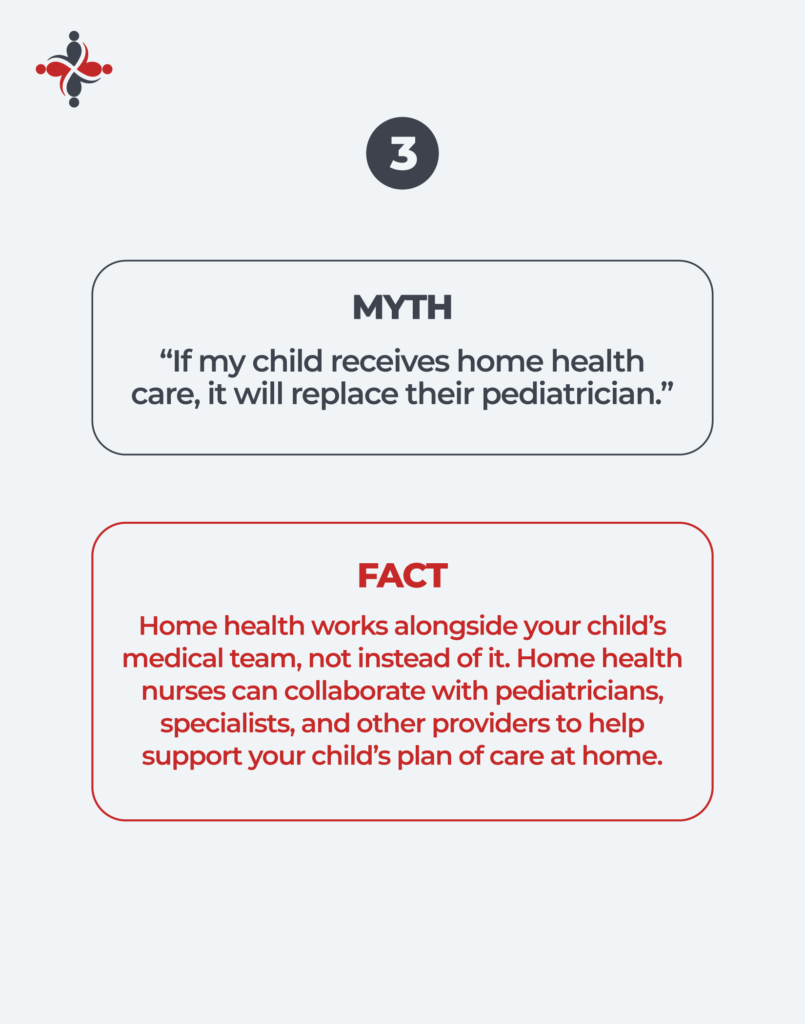
Many parents wonder whether a pediatric home health nurse can support their child at school.
In some cases, yes. A nurse may be able to accompany a child to school or provide support during school hours when the service is medically necessary, authorized, included in the care plan, and allowed under payer, state, school, and agency requirements.
This can be especially important for children who need skilled nursing support during the day, such as respiratory monitoring, tracheostomy care, ventilator support, feeding support, seizure monitoring, medication administration, or other skilled care based on physician orders.
School support is not automatic, and it can involve coordination between the family, physician, payer, school team, case manager, and home health care provider. But parents should know that pediatric home health care is often about supporting a child’s life, not limiting it. CMS notes that services provided in schools can play an important role in the health care of children and adolescents, depending on the delivery model and Medicaid requirements.
For many children, the goal is to help them receive the care they need while participating as fully and safely as possible in daily routines, school, therapies, and family life.
Myth 4: Pediatric Home Health Care Only Means Medical Tasks
Pediatric home health care includes skilled clinical care, but its impact often reaches beyond the task itself.
A child’s care plan may include services such as respiratory care, tracheostomy support, ventilator support, oxygen monitoring, feeding tube care, medication administration, seizure monitoring, mobility support, documentation, and communication with the broader care team. The exact services depend on the child’s needs, physician orders, payer authorization, state requirements, and available services.
But families often experience the support in everyday ways.
It may help make mornings more manageable. It may help parents feel less alone during overnight care. It may support school participation. It may give siblings more time with parents. It may help create more consistent routines around medications, feeding, equipment, or monitoring.
Pediatric home health care is clinical care delivered within the rhythm of family life. That is what makes it meaningful for many families. The care supports the child’s medical needs while also helping families create more stability, communication, and confidence at home.
Myth 5: Private Duty Nursing Is the Same as a Short Nursing Visit
Private Duty Nursing, also called PDN, is different from a short nursing visit.
A short skilled nursing visit may focus on a specific need during a limited visit window. Private Duty Nursing is typically longer-duration, one-on-one skilled nursing care for children who require ongoing support due to complex or chronic medical needs.
Team Select describes Private Duty Nursing as one-on-one, long-term skilled nursing care delivered at home for medically complex children and adults. Team Select also notes that its teams partner with families, physicians, and hospital discharge teams to support medically fragile patients at home.
Children who may qualify for pediatric Private Duty Nursing often need ongoing skilled nursing support that cannot be fully managed through occasional visits alone. This may include children with tracheostomies, ventilators, feeding tubes, oxygen needs, seizure monitoring needs, complex medication routines, or other skilled care needs based on physician orders and payer requirements.
Eligibility depends on the child’s condition, medical necessity, physician documentation, insurance or Medicaid requirements, state guidelines, and available nursing support.
Families should not assume they need to know whether their child qualifies before reaching out. A local pediatric home health care provider can help review the child’s care needs and explain what information may be needed to determine next steps.
Myth 6: A Home Health Nurse Will Replace Me as the Parent
No. A pediatric home health nurse does not replace the parent.
Parents remain central to their child’s life, routines, care decisions, comfort, and advocacy. You know your child’s expressions, preferences, baseline, personality, and history in ways no one else can.
A pediatric home health nurse brings skilled clinical support into the home. The nurse follows physician-directed care plans, provides nursing care within their scope of practice, documents care, communicates concerns, and works alongside the family to support the child’s needs.
That partnership matters.
For many families, pediatric home health care can help parents feel more supported, not less involved. It may give parents time to rest, care for siblings, attend appointments, manage household responsibilities, or simply enjoy more moments as Mom or Dad instead of carrying every medical responsibility alone.
The goal is not to take over. The goal is to build support around the child and family.
What Pediatric Private Duty Nursing Actually Looks Like
Pediatric Private Duty Nursing is one-on-one skilled nursing care for a child with ongoing medical needs.
Unlike a short visit, PDN often supports a child for longer periods of time based on the authorized plan of care. A pediatric private duty nurse may provide hands-on skilled care, monitor changes in the child’s condition, document care, communicate with the broader care team, and support daily routines that require clinical attention.
The nurse’s role depends on the child’s physician-directed care plan, nursing scope of practice, payer authorization, state requirements, and the family’s needs.
In the home, that may look like a nurse helping manage respiratory care, feeding tube routines, seizure monitoring, medication administration, equipment support, or other skilled needs. It may also look like a nurse learning the child’s routine, understanding their baseline, partnering with parents, and helping create consistency across shifts.
Private Duty Nursing is deeply personal because the nurse is not caring for a room full of patients. They are focused on one child and one family. That one-on-one setting allows nurses to better understand the child’s needs, routines, communication style, and changes over time.
Learn More About Private Duty Nursing
Who May Benefit From Pediatric Home Health Care?
Pediatric home health care may benefit children who have medical needs that require skilled care or support outside of a hospital or facility setting.
This may include children with respiratory needs, tracheostomies, ventilators, feeding tubes, oxygen support, seizure monitoring needs, medication routines, mobility needs, developmental needs, or support after a hospital or NICU stay. It may also include children whose families need additional education, care coordination, or help managing daily medical routines at home.
Not every child will qualify for every service. Eligibility depends on medical need, physician orders, payer requirements, state program rules, authorized services, staffing availability, and location.
The most important thing for families to know is that asking questions does not commit them to services. It simply helps them understand what may be available.
If your child has ongoing medical needs and you are wondering whether pediatric home health care may be appropriate, it may be time to speak with your child’s physician, case manager, payer, or local Team Select office.
What Care Can Look Like Beyond the Home
Pediatric home health care is often associated with the home, but care may sometimes support a child in other approved settings where normal life activities take place.
For some children, this may include school. For others, support may be connected to appointments, therapies, or approved community routines. What is allowed depends on medical necessity, payer authorization, state requirements, school policies, the child’s care plan, and staffing availability.
This matters because children with medical needs are still children. They may go to school, participate in therapies, attend family events, build relationships, celebrate milestones, and experience everyday childhood moments.
When nursing support is authorized beyond the home, it can help families feel more confident that their child’s care needs are being supported during important parts of daily life.
At Team Select, real patient stories often show what this can look like in practice. A pediatric nurse may support a child at school, during appointments, or during meaningful community moments when appropriate and authorized. These experiences reflect one of the most important goals of pediatric home health care: helping children receive needed care while still participating in life as fully as possible.
See how pediatric home health care can support daily life beyond the home.
What Role Do Parents Have?
Parents remain essential before, during, and after pediatric home health care begins.
A nurse may bring clinical training, documentation, skilled care, and support with physician-directed tasks, but parents bring something no one else can replace: deep knowledge of their child.
Parents often know the small details that matter most. They know what their child’s normal breathing looks like. They know which routines bring comfort. They know what a certain expression means. They know when something feels off, even before it appears clearly in a chart.
That knowledge matters to the care team.
The strongest pediatric home health care relationships are built around partnership. Nurses and families communicate, learn from one another, and work together to support the child’s needs.
Accepting nursing support does not mean giving up control. It means building a care team around your child so your family does not have to carry every responsibility alone.
How Do I Know What Services My Child May Qualify For?
The best way to understand what services your child may qualify for is to start a conversation.
A physician, hospital discharge planner, case manager, payer, or pediatric home health care provider can help determine what documentation is needed and whether services such as pediatric home health care, Private Duty Nursing, school support, or family caregiver programs may be available.
Families may want to ask:
- Does my child have medical needs that may require skilled care at home?
- Does my child need physician orders or a written plan of care?
- Could Private Duty Nursing be appropriate?
- Can nursing support be provided during school hours if medically necessary and authorized?
- What services are covered by my child’s Medicaid or insurance plan?
- Are there family caregiver programs available in my state?
- What documentation is needed to begin the process?
- Who helps coordinate next steps?
You do not need to know the answers before reaching out. The purpose of the conversation is to help you understand the options.
Pediatric Home Health Care Near Me: Why Local Support Matters
Pediatric home health care is often local by nature.
Coverage rules, Medicaid programs, family caregiver programs, school support, service availability, staffing, and authorization requirements may vary by state and location. That is why families searching for pediatric home health care near them should connect with a provider that understands local requirements and can help explain available options.
Team Select Home Care supports families of medically complex children by helping them explore pediatric home health care, Private Duty Nursing, family support resources, and care options based on each child’s needs and location.
A local Team Select office can help families ask the right questions, understand possible next steps, and connect with available services when eligibility and program requirements are met.
Frequently Asked Questions and Common Myth vs Facts About Pediatric Home Health Care

