
Nurse burnout is no longer just a seasonal awareness topic. It is part of a larger conversation about the future of nursing, workforce retention, flexibility, safety, and long-term career sustainability.
According to NCSBN’s national nursing workforce research, the U.S. nursing workforce has shown signs of recovery, but long-term stability remains uncertain and staffing challenges, stress, and burnout continue to affect the profession.
Many nurses enter the profession because they care deeply about people. They want to make a difference, support patients through vulnerable moments, and provide care that matters. But when the work environment becomes overwhelming, even the most passionate nurses can begin to feel exhausted, discouraged, or unsure about their future in the profession.
In 2026, the conversation around nurse burnout has moved beyond simply recognizing the problem. Nurses, employers, and healthcare leaders are asking a more important question: What does a more sustainable nursing career actually look like?
For some nurses, the answer may not be leaving nursing altogether. It may be exploring a different care setting, such as private duty nursing or home health care, where the pace, patient relationships, and schedule options may better support long-term balance.
Quick Answer: Can Private Duty Nursing Help Nurses Experiencing Burnout?
Private duty nursing may help some nurses experiencing burnout by offering a more focused, one-on-one care environment, stronger patient relationships, and more flexible scheduling options depending on the role, patient needs, and location.
While private duty nursing is not a cure for burnout, it can give nurses a different way to continue meaningful patient care outside of fast-paced hospital or facility settings. For nurses who still love caring for patients but feel drained by high patient loads, competing demands, or unpredictable schedules, private duty nursing may offer a more sustainable path.
Why Nurse Burnout Still Matters in 2026
Nurse burnout remains one of the most important workforce issues in healthcare.
Recent workforce research continues to show that nurses are still facing major challenges related to stress, staffing, retention, and workplace well-being. NCSBN’s workforce research has pointed to ongoing concerns around nurses leaving the workforce and intent to leave in the coming years, reinforcing that burnout and staffing challenges are not short-term issues.
Nurse.com’s 2026 burnout reporting found that 53% of nurses reported experiencing burnout during the previous two years, while 62% reported feeling overwhelmed. Cross Country Healthcare and Florida Atlantic University’s 2026 State of Nursing Report also frames the current nursing climate as one where purpose remains strong, but nurses are still under pressure and seeking better support.
For nurses, this matters because burnout is not just about feeling tired after a hard shift. It can affect career satisfaction, emotional well-being, patient care, team stability, and whether nurses feel they can stay in the profession long term.
What Nurse Burnout Can Look Like
Nurse burnout can show up in different ways. For some nurses, it may feel like constant exhaustion. For others, it may look like emotional fatigue, reduced motivation, irritability, compassion fatigue, dread before a shift, or feeling disconnected from work that once felt meaningful.
The American Nurses Association describes nurse burnout as something that can be tied to long hours, challenging situations, feeling overworked, and not feeling appreciated or supported. Nurse burnout can show up in different ways. For some nurses, it may feel like constant exhaustion. For others, it may look like emotional fatigue, reduced motivation, irritability, compassion fatigue, dread before a shift, or feeling disconnected from work that once felt meaningful. The American Nurses Association offers helpful guidance on nurse burnout signs and prevention for nurses who may be experiencing these symptoms.
Burnout does not mean a nurse is weak. It does not mean they are no longer good at their job. And it does not always mean they have lost their passion for care.
Many times, burnout is a sign that the current work environment is no longer sustainable.
Why Work Environment Matters
Nursing will always involve responsibility, compassion, and emotional investment. But the setting where care happens can make a major difference in how sustainable the work feels over time. In some healthcare environments, nurses may be managing multiple patients, high acuity, constant interruptions, rotating shifts, documentation demands, and little time to reset between responsibilities. Over time, those pressures can make it difficult to recover physically or emotionally.
Burnout is not only an individual issue. The CDC/NIOSH Impact Wellbeing Guide encourages healthcare organizations to take a systems approach to workforce well-being, focusing on operational-level improvements rather than placing the burden only on individual resilience. That perspective matters because nurses need both personal coping strategies and supportive work environments.
That is why many nurses are beginning to think more intentionally about work environment, not just job title. A nurse may still love patient care but need a setting that offers more focus. They may still want to use their clinical skills but need more predictable routines. They may still feel called to care but want stronger relationships with patients and families.
For some nurses, private duty nursing creates that different kind of environment.
Hospital Nursing vs. Private Duty Nursing: What’s Different?
Hospital and facility-based nursing are essential to the healthcare system. These settings support patients through urgent needs, procedures, acute illness, recovery, and complex care situations.
But private duty nursing offers a different model of care. In private duty nursing, care often happens in the patient’s home and typically focuses on one patient at a time. This can allow nurses to build deeper relationships, follow more consistent routines, and provide care in a more personal environment.
Here is a high-level comparison:
| Category
|
Hospital or Facility Nursing
|
Private Duty Nursing / Home Health
|
| Care setting | Hospital, facility, or clinical unit | Patient’s home |
| Patient load | Multiple patients during a shift | Often one patient at a time |
| Pace | Fast-moving, high-acuity, competing priorities | More focused, routine-based, and relationship-centered |
| Schedule | May include rotating shifts, nights, weekends, and holidays | May offer more choice, consistency, or flexibility depending on case needs |
| Patient relationship | Often shorter-term or task-focused | Often longer-term and more personal |
| Autonomy | Team-based care with facility oversight | More independence within the patient’s plan of care |
| Support needs | Immediate on-site team access | Requires strong communication with clinical and local support teams |
Private duty nursing can still include complex care, nights, weekends, holidays, and high-responsibility assignments. The difference for many nurses is the ability to focus on one patient at a time and choose opportunities that better align with their schedule, skills, and goals.
Why Some Nurses Are Exploring Private Duty Nursing in 2026
For nurses who still love patient care but feel drained by constant competing demands, private duty nursing may offer a different kind of clinical experience. Instead of moving from room to room or balancing several patients at once, private duty nurses can often focus deeply on one patient’s needs, routines, progress, and family environment. That one-on-one focus can feel meaningful for nurses who want to slow down, build trust, and see the long-term impact of their care.
Private duty nursing may appeal to nurses who are looking for:
- More one-on-one patient care
- Stronger patient and family relationships
- A more focused care environment
- Flexible scheduling options
- Pediatric or adult home health opportunities
- A more personal connection to patient progress
- A way to continue nursing in a different setting
For many nurses, burnout does not come from a lack of purpose. It comes from trying to provide excellent care in an environment that no longer feels manageable. Private duty nursing can help some nurses reconnect with the parts of nursing that brought them into the profession in the first place.
Burnout Does Not Always Mean Leaving Nursing
When nurses experience burnout, it can be easy to wonder whether they need to leave nursing completely. But for many nurses, the real question is not, “Do I still want to be a nurse?” The better question may be, “Is there a different nursing environment that would help me feel supported again?”
Many nurses considering a career change are not trying to leave care behind. They are trying to find a setting where the care they provide feels sustainable, personal, and meaningful.
Private duty nursing is one option for nurses who want to continue making a direct impact while exploring a different pace, setting, and patient relationship.
5 Ways to Lower Stress as a Home Health Nurse
Even in a more focused, one-on-one care environment, nursing still requires energy, attention, and emotional presence. That is why small routines can make a meaningful difference.
For home health and private duty nurses, lowering stress is not just about getting through a shift. It is about building habits that support safe care, clear communication, and long-term career
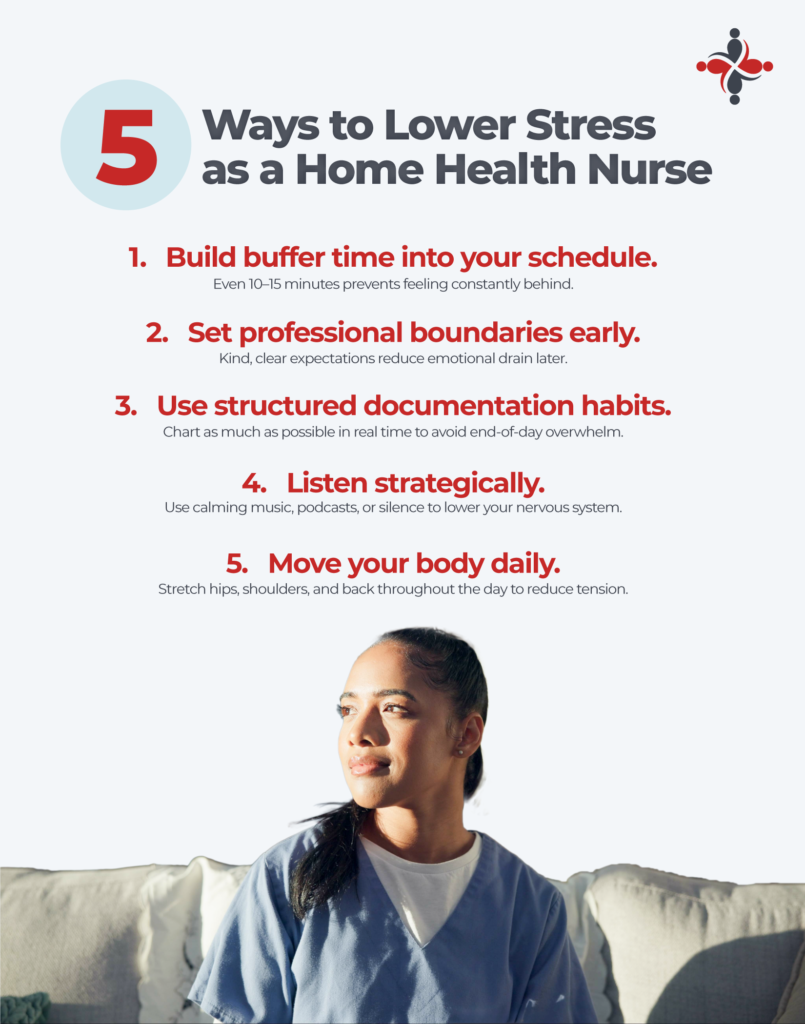
1. Build buffer time into your schedule so care feels less rushed
In private duty nursing, consistency matters. A few extra minutes before a shift can help nurses review the patient’s care plan, prepare for the day, communicate with the family, and mentally transition into the home environment.
This kind of preparation can be especially helpful when caring for medically fragile children or adults who rely on consistent routines. Instead of arriving already feeling behind, nurses can begin the shift with more focus and confidence. Buffer time can also support better communication at shift changes. When nurses have space to review updates, ask questions, and document important details, it helps promote continuity of care for the patient and a smoother experience for the family.
2. Set professional boundaries that support healthy patient and family relationships
One of the most meaningful parts of home health nursing is the relationship nurses build with patients and families. In private duty nursing, nurses may support the same patient over time, which can create trust, familiarity, and a strong sense of connection.
Healthy boundaries help protect those relationships.
Clear expectations around communication, responsibilities, privacy, and the nurse’s role can reduce confusion and emotional strain. Boundaries do not make care less compassionate. They help make care more sustainable, respectful, and consistent. For nurses in the home setting, this balance is important. Families should feel supported, and nurses should feel confident in their role as skilled care professionals.
3. Use documentation habits that strengthen communication and continuity of care
Documentation is more than a task to finish at the end of a shift. In home health and private duty nursing, clear documentation helps support communication between nurses, families, clinical supervisors, and the broader care team.
When nurses document throughout the shift when appropriate, details are often more accurate and easier to recall. This can help reduce end-of-day stress while also supporting high-quality care.
Strong documentation habits can also help the next nurse understand what happened during the shift, what changed, what the patient tolerated well, and what may need follow-up. For patients with ongoing medical needs, that continuity can make a meaningful difference.
4. Create calming transitions before and after each shift
Home health nurses often move between personal life and a deeply focused care environment. Creating a calming transition before and after a shift can help nurses reset mentally and emotionally. For some nurses, that may mean listening to calming music, an encouraging podcast, or a quiet playlist on the way to work. For others, it may mean choosing silence, deep breathing, or a few minutes to review priorities before entering the home.
The goal is not to ignore stress. The goal is to create a rhythm that helps the body and mind prepare for care, then decompress afterward. Over time, these small transitions can help nurses protect their energy and maintain a healthier relationship with their work.
5. Move your body to reduce physical tension and support long-term well-being
Nursing is physical work, even in a home setting. Long shifts, patient care tasks, sitting during documentation, lifting, repositioning, and repeated movements can all create tension in the body.
Small movement habits can help. Stretching the shoulders, neck, hips, and back throughout the day may help nurses feel more comfortable and less physically drained. Even short moments of movement between tasks or after documentation can support circulation, posture, and stress relief.
How to Know If Private Duty Nursing May Be a Better Fit
Private duty nursing may be worth exploring if you still love nursing but feel overwhelmed by high patient loads, competing priorities, or the pace of your current environment. It may also be a strong fit if you want more one-on-one time with patients, prefer a more consistent care routine, value long-term patient relationships, or want more choice in your schedule.
For nurses interested in pediatric care, medically complex care, or supporting patients and families at home, private duty nursing can offer a meaningful way to use clinical skills in a more personal setting. The goal is not to say one nursing path is better than another. The goal is to help nurses understand that there are different ways to build a meaningful career in nursing.
Finding a More Sustainable Nursing Career
A sustainable nursing career looks different for every nurse. For one nurse, it may mean staying in a hospital but moving to a different unit. For another, it may mean shifting into education, leadership, case management, or care coordination. For others, it may mean exploring home health or private duty nursing.
A sustainable nursing career looks different for every nurse, but current healthcare workforce conversations continue to point toward the same themes: stronger support, better retention, safer staffing, flexibility, and long-term well-being.
The important thing is recognizing that burnout does not have to be ignored until it becomes a breaking point. Nurses deserve to explore work environments where they can provide high-quality care while also protecting their own well-being, energy, and long-term career goals. Private duty nursing is one path that may help nurses find a better fit.
The Team Select Difference
At Team Select Home Care, nurses provide one-on-one care to medically fragile children and adults in the home. Our private duty nursing model is built around relationship-based care, family collaboration, clinical support, and the belief that nurses should feel supported in the meaningful work they do.
For nurses who want a different kind of care environment, Team Select offers opportunities to support patients in a more personal setting while building consistent relationships with families and local care teams. Depending on location, role, and patient needs, Team Select nurses may have access to flexible scheduling opportunities, pediatric and adult care options, local team support, clinical oversight, and meaningful one-on-one patient care.
At Team Select, our mission is to change lives for the better. That includes the lives of the patients we serve, the families we support, and the nurses who make care possible every day.
Explore a Different Nursing Path
Feeling burned out does not have to mean walking away from nursing.
A different care setting may help you reconnect with the purpose, relationships, and patient impact that brought you into the profession. Explore private duty nursing opportunities with Team Select Home Care and find a role that supports your career, your patients, and your well-being.
Nurse Burnout and Private Duty Nursing FAQs
Contact Team Select Today

